A Biblical Guide for Pastors and Church Leaders
Understanding Mental Health, Faith, and the Church: A Biblical Framework for Soulcare Is mental health a spiritual issue?
Pastors and church leaders are increasingly finding themselves walking alongside people experiencing anxiety, depression, grief, trauma, marital conflict, emotional distress, and other mental-health concerns. But how should the church respond? Is mental health primarily a spiritual issue, a psychological issue, or both?
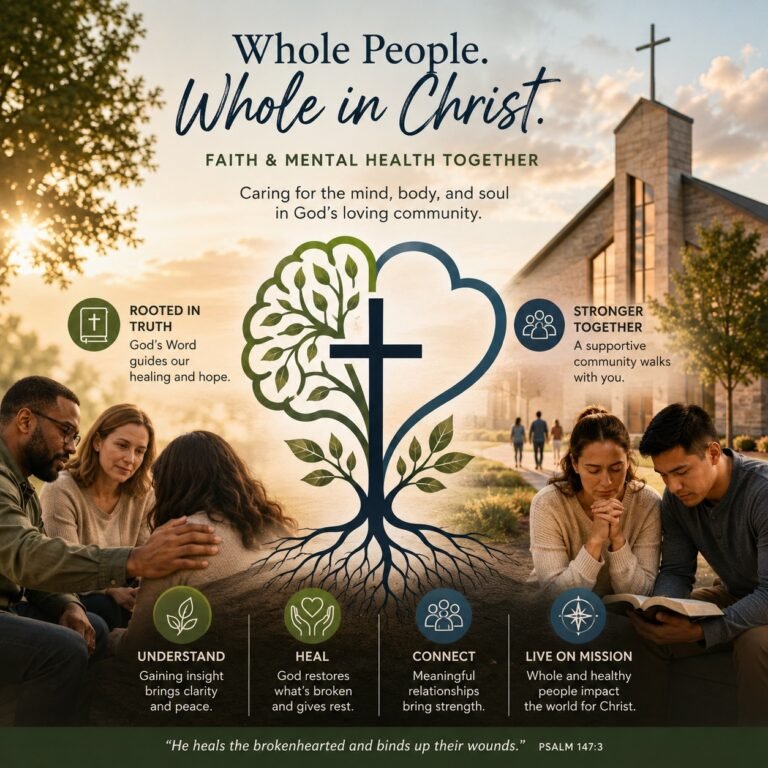
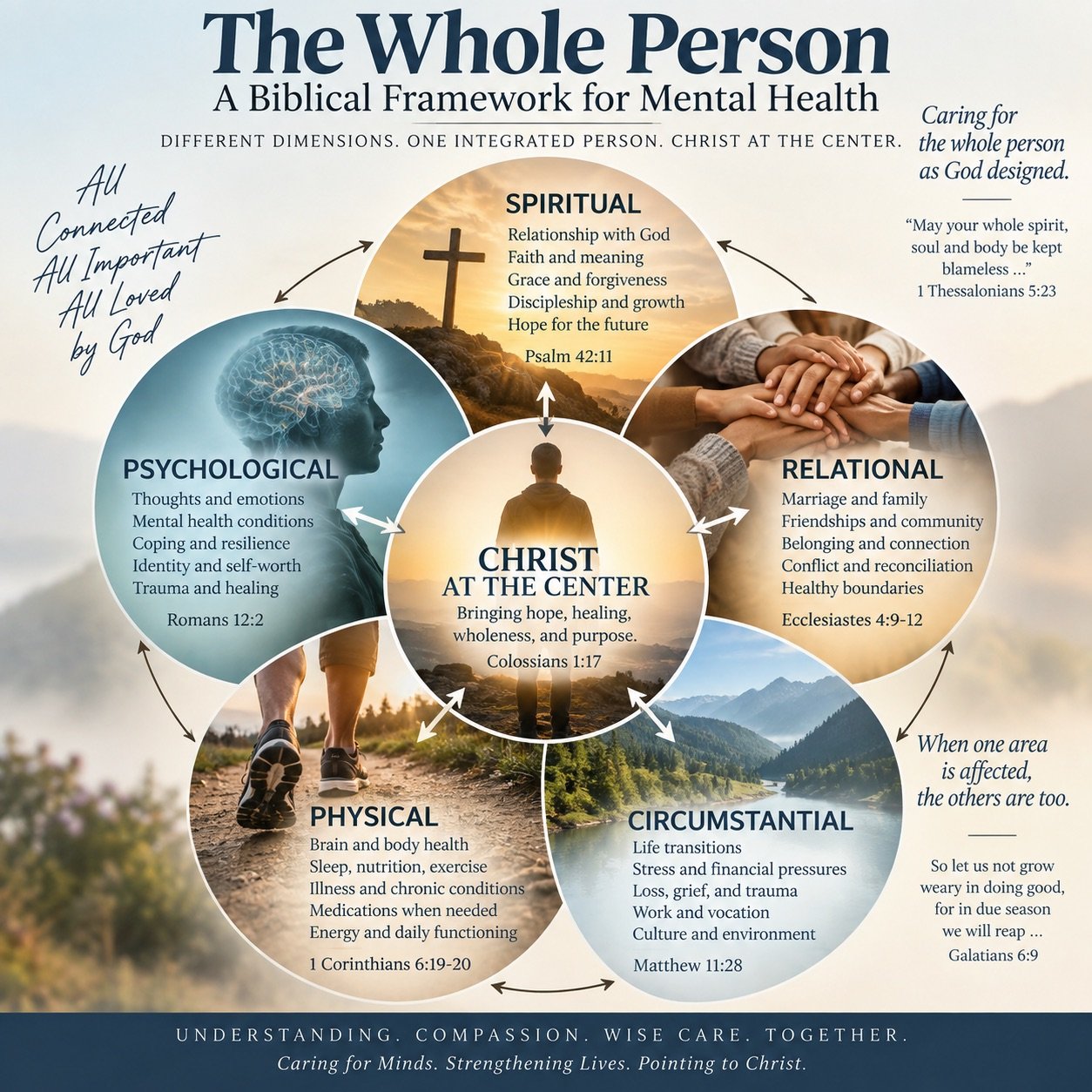
For Christian pastors and church leaders, this question matters because the church is called to care for the whole person—spiritually, emotionally, relationally, mentally, and physically.
The answer is yes: mental health has a spiritual dimension, but it is not exclusively a spiritual issue. Understanding that distinction can help churches move beyond stigma and overly-simplified answers toward compassionate, Biblically grounded, whole-person care.
────────
We Live in a Fallen World
To understand mental health from a Christian perspective, we have to begin with the reality of the Fall.
Something fundamentally changed when sin entered the world.
The Fall of man is recorded in the Genesis, Chapter 3. Here, read the real story of Adam and Eve’s willful choice to disobey God and eat of the tree of Good and Evil in the Garden of Eden. This choice did not simply introduce sinful behavior. It brought brokenness into the human experience and resulted in a wall of separation between God and man.
Because we live in a fallen world, we experience brokenness physically, emotionally, relationally, mentally, and spiritually. We experience illness, suffering, distorted thinking, relational conflict, grief, shame, temptation, and ultimately death.
This does not mean that every illness or mental-health condition is the direct result of an individual’s personal sin.
Rather, the Fall provides the larger theological context for human brokenness.
We live in a world that is not yet what God ultimately intended it to be.
And that reality includes believers.
────────
Redeemed—But Not Yet Glorified
One of the most important truths for Christians to understand is that salvation does not mean every consequence of the Fall immediately disappears.
We can think about our Christian journey in three ways:
Justification
We have been declared righteous through Christ.
Sanctification
We are progressively being transformed as we grow in Christ.
Glorification
One day, when we are with Christ, we will be completely freed from the presence and effects of sin.
Until then, believers continue to live in a fallen world and experience the effects of that brokenness. The Apostle Paul
talks about the struggle that believers face, in Romans Chapter 7. A person can genuinely belong to Christ and still struggle deeply because of the Old Sin nature that still wars against the New and redeemed Spirit.
The presence of struggle does not necessarily mean the absence of faith.
Being saved does not mean that we stop being human.
────────
The Effects of the Fall Reach the Whole Person We often think about the old sin nature primarily in terms of sinful choices—pride, selfishness, anger, lust, greed, disobedience, and temptation.
But human brokenness is experienced throughout the whole person.
Physically
We experience illness, weakness, aging, pain, disease, and death.
Emotionally
We experience fear, grief, anger, shame, despair, and profound distress.
Mentally
People may experience intrusive thoughts, impaired functioning, psychological suffering, and mental illness.
Relationally
We experience conflict, mistrust, betrayal, isolation, broken families, and difficulty with intimacy.
Spiritually
We experience temptation, guilt, shame, spiritual confusion, and struggles with faith.
The important distinction is this:
The effects of the Fall are not the same thing as personal sin.
A person may experience depression, anxiety, trauma, or another mental-health condition without having committed a particular sin that caused it.
Mental illness is not proof that someone has failed spiritually any more than physical illness is proof that someone has failed spiritually.
This distinction is especially important for churches and pastors who want to provide wise and compassionate mental-health care.
────────
Christians Are Not Immune to Human Brokenness
Sometimes Christians unconsciously believe:
“If I am really walking with God, I shouldn’t struggle this way.”
But Scripture does not promise believers will be exempt from suffering.
Faithful people experience grief, fear, exhaustion, loneliness, persecution, physical illness, and emotional pain.
A Christian can love Jesus, pray, read Scripture, attend church, serve others, and have a strong faith—and still experience significant mental-health difficulties.
Why?
Because redemption is not the same thing as glorification.
We are already Christ’s, but we are not yet completely restored.
This is part of the challenge of the Christian life:
Already—but not yet.
In Christ, we already have forgiveness, reconciliation with God, the Holy Spirit, a new identity, spiritual life, hope, and the beginning of transformation.
But we still experience suffering, temptation, illness, aging, relational brokenness, emotional struggles, mental-health difficulties, and death.
Romans 8 points us toward the hope that one day creation itself will be fully restored.
That is where our hope must ultimately rest.
────────
So, Is Mental Health a Spiritual Issue?
Yes—but it is not exclusively a spiritual issue.
Mental health belongs within the larger story of:
Creation → Fall → Redemption → Sanctification → Glorification
Our spiritual lives matter deeply. Our relationship with God affects how we understand suffering, our identity in Christ, forgiveness, hope, purpose, and meaning.
At the same time, mental-health struggles can affect our spiritual experience.
A person who is depressed may say:
“I can’t feel God.”
Someone experiencing anxiety may struggle to experience peace.
Someone carrying shame may believe:
“God couldn’t possibly love someone like me.”
Someone who has experienced trauma may struggle to trust God or other people.
The relationship goes both directions.
This is why pastors and church leaders need to resist the temptation to separate the spiritual from everything else.
────────
The Church Must Not Confuse Sin With Sickness
This may be one of the most important distinctions for Christian mental-health ministry.
Sin asks:
What choice have I made that needs repentance?
Sickness asks:
What is happening to me that requires care?
Sometimes they overlap.
Sometimes they don’t.
A person may need repentance and forgiveness. They may also need counseling, medical care, medication, spiritual support, relationship repair, or several of these at the same time.
Not everything that hurts us is something we have sinned to cause.
And not everything we do in response to our pain is healthy or without natural consequence.
Wise pastoral care requires us to recognize the difference.
────────
The Church Needs to Change the Conversation About Mental Health
If every mental-health struggle is interpreted as:
“You have a spiritual problem,”
people may become afraid to speak honestly.
And when people are afraid to speak, they often hide.
But when the church says:
“Let’s understand the whole person,”
we create emotional safety.
And emotional safety creates the possibility for honesty.
Safety → Trust → Vulnerability → Honesty → Growth
People are more likely to seek help when they believe they will be heard rather than judged.
This is why pastors and church leaders need to learn to listen before they try to fix.
────────
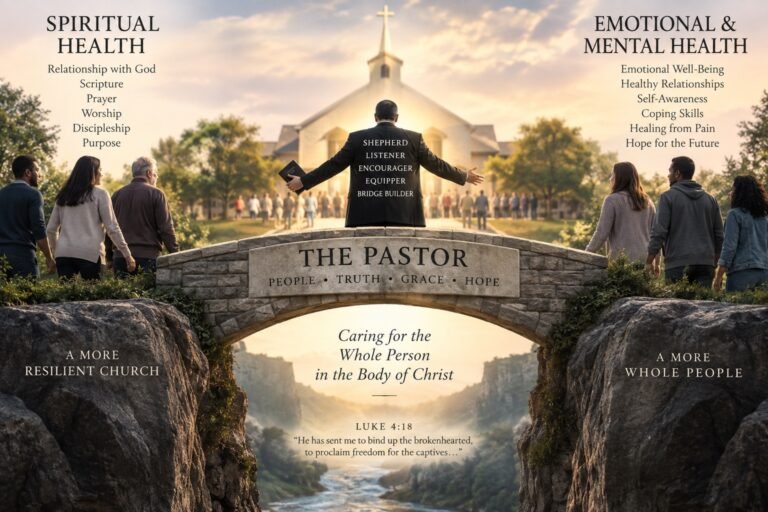
The Holy Spirit Is Not in Competition With Professional Care
Spiritual care and professional mental-health care do not have to be competing systems.
God can work through many legitimate means of bringing wisdom, support, healing, and stability. God’s sovereignty extends to mental health oversight just as it does spiritual care.
The church provides spiritual care through:
-
prayer
-
Scripture
-
discipleship
-
pastoral care
-
community
-
encouragement
-
the work of the Holy Spirit
People also need relational care through:
-
family
-
friends
-
mentors
-
marriage relationships
-
church community
And there are times when professional mental-health care is appropriate through:
-
counseling
-
psychological services
-
psychiatric care
-
medical care
The goal isn’t to replace one kind of care with another.
The goal is to care for the whole person.
The church does not have to choose between faith and mental-health care.
────────
A New Question for Pastors
Perhaps pastors should stop asking:
“Is this spiritual or mental?”
And begin asking:
“What is happening to this whole person?”
What is happening spiritually?
What is happening emotionally?
What is happening mentally?
What is happening relationally?
What is happening physically?
What has happened to this person?
What choices are they making?
And most importantly:
What kind of care does this person need?
A pastor does not have to diagnose a person to care for them well.
But pastors do need to recognize when something may require professional help.
────────
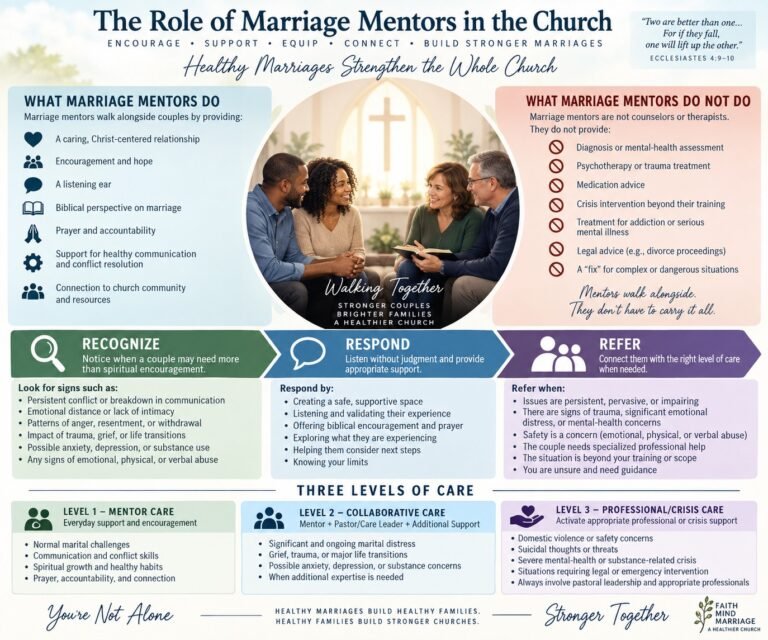
Recognize. Respond. Refer. Remain.
A simple framework can help church leaders respond to mental-health concerns.
RECOGNIZE
Recognize that mental-health struggles can occur in faithful Christians.
RESPOND
Listen with compassion rather than immediately assigning blame or giving simplistic spiritual answers.
REFER
Know when professional or specialized mental-health care is needed.
REMAIN
Continue to provide appropriate spiritual community and support.
Referral does not have to mean:
“You’re someone else’s problem.”
It can mean:
“Let’s help you find the kind of care you need, and we’ll continue to walk alongside you appropriately.”
────────
Creating a Church Where People Can Be Honest
If churches want to become healthier places for people struggling with mental and emotional health, we need to create environments where people feel safe enough to tell the truth.
Emotional safety does not mean eliminating Biblical truth, accountability, repentance, or personal responsibility.
It means creating an environment where people can be honest without being immediately shamed or dismissed.
People grow when they feel safe.
When people feel safe, they are more likely to become vulnerable.
When they become vulnerable, they can become honest.
And when people are honest about what is really happening, meaningful growth and appropriate care become possible.
This is one of the most important opportunities for pastors, mentors, small-group leaders, and other church leaders today.
────────
We Are Living Between Redemption and Restoration
Ultimately, this is a message of hope.
The brokenness we experience now is not the final word.
We live between redemption and restoration. We are already Christ’s, but we are not yet completely free from the effects of the Fall.
Until we are with Christ, we may experience brokenness in our bodies, our minds, our emotions, and our relationships.
That does not make us less Christian. It makes us human beings living in a fallen world while waiting for complete redemption.
So, is mental health a spiritual issue?
Yes. But it is also physical, emotional, relational, and psychological.
If we care for the whole person, we are not minimizing the spiritual. We are recognizing the full reality of the person God created, the brokenness introduced through the Fall, and the redemption Christ is bringing to completion.
Perhaps the church doesn’t need to choose between spiritual care and mental-health care.
Perhaps we need to learn how to bring them together in a way that reflects the way God cares for the whole person.
We don’t have to become a mental-health clinic. We do need to become a church where people don’t have to hide their mental and emotional struggles in order to belong.