Caring for the People Who Spend Their Lives Caring for Others
There is a question I believe the church needs to ask more often:
Who is caring for the caregiver?
We are very good at talking about how to care for people who are hurting.
We train pastors to shepherd. We train mentors to listen. We encourage small-group leaders to notice when someone is struggling. We teach people how to pray, encourage, support, and walk alongside others.
And all of that is important.
But there is another person sitting in the room who can easily be overlooked:
The person doing the caring.
The pastor who has listened to one more difficult story.
The mentor who has walked with a couple through months of marital conflict.
The small-group leader who knows what is happening in someone’s life but can’t talk about it with anyone else.
The person who gets the phone call late at night.
The counselor who spends the day listening to other people’s pain.
The ministry leader who keeps showing up because people are counting on them.
These people love deeply. They serve faithfully. And they often don’t want to make their own needs the focus.
But sometimes, without realizing it, they begin carrying things they were never meant to carry alone.
Caregivers Are Human Too
One of the dangers of being a caregiver is that people can begin to see you primarily through your role.
You’re the pastor.
You’re the mentor.
You’re the counselor.
You’re the ministry leader.
You’re the person who has the answers.
You’re the person other people come to when they don’t know what to do.
But underneath the role is a person.
A person who gets tired.
A person who has emotions.
A person who has limits.
A person who experiences disappointment.
A person who can be affected by the stories they hear.
A person who sometimes needs someone else to ask,
“How are you doing?”
And mean it.
We cannot ask people to care for others in healthy ways if we don’t also create a culture where caregivers are allowed to be cared for.
Jesus Modeled the Need for Rest
There is something important we see throughout Scripture.
Jesus cared deeply for people. He taught. He healed. He listened. He responded to suffering. He carried enormous responsibility.
But Jesus also withdrew.
He went away to pray. He spent time with the Father. He rested. He wasn’t available to everyone, every moment, for every need.
That is important for those of us who work in ministry to remember.
Being available is not the same thing as being healthy.
And setting a boundary is not the same thing as being uncaring.
Sometimes the healthiest thing a caregiver can say is:
“I can’t carry this alone.”
We Were Never Designed to Carry Everyone’s Burden
There is an interesting tension in Galatians 6.
We are told to bear one another’s burdens. But only a few verses later, we are also reminded that each person has a load to carry.
I think there is wisdom in that tension.
We are called to help one another.
But we are not called to become one another’s savior.
That distinction matters.
A mentor can walk alongside someone without taking responsibility for their outcome.
A pastor can provide spiritual care without becoming responsible for solving every problem.
A counselor can help someone process deep pain without taking that pain home as their own.
A caregiver can love someone deeply without carrying that person’s entire life on their shoulders.
Compassion does not require us to carry what belongs to someone else.
When Caring Becomes Carrying
There is a difference between caring for someone and carrying someone.
Caring says:
“I’m here with you.”
Carrying can begin to sound like:
“It’s my responsibility to make this better.”
Caring says:
“Let’s figure out what support you need.”
Carrying says:
“If this person doesn’t get better, I have failed.”
Caring says:
“I will walk alongside you.”
Carrying says:
“I have to fix this.”
That distinction is especially important in ministry because caregivers are often motivated by love.
And sometimes love makes it difficult to recognize when we have crossed a boundary.
How Do I Know When I’m Carrying Too Much?
One question I encourage caregivers to ask themselves is:
“Am I still able to care for this person without carrying their pain as my own?”
That is a powerful question.
We may need to pay attention when we begin:
-
Thinking about someone’s situation constantly
-
Losing sleep because of what they are experiencing
-
Feeling personally responsible for their outcome
-
Becoming unusually anxious or fearful
-
Feeling that we must always be available
-
Becoming emotionally overwhelmed
-
Resenting the amount of care someone needs
-
Ignoring our own family or personal responsibilities
-
Having difficulty separating someone else’s crisis from our own life
-
Feeling guilty when we set appropriate boundaries
None of these automatically mean a caregiver is doing something wrong.
They may simply be signals.
Signals that say:
“I need care too.”
Listening Is Ministry—But Listening Has a Cost
One of the things I emphasize in training mentors is that listening itself is ministry.
We don’t always have to fix.
Sometimes people need someone to sit with them.
To hear them.
To help them put words to what they are experiencing.
To remind them that they are not alone.
But listening is not emotionally neutral.
When we listen deeply to another person’s pain, it can affect us.
That is why caregivers need places where they are the one who gets to talk.
Pastors need pastors.
Mentors need mentors.
Counselors need their own places of support and consultation.
Ministry leaders need people who know them well enough to ask the questions they may not ask themselves.
The caregiver needs somewhere to take what they have been carrying.
The Caregiver Needs Emotional Safety Too
We spend a lot of time talking about creating emotional safety for the people we serve.
But caregivers need emotional safety too.
They need a place where they don’t have to be the strong one.
A place where they can say:
“I’m struggling.”
“I don’t know what to do.”
“This situation is affecting me.”
“I’m angry.”
“I’m tired.”
“I’m afraid.”
“I need help.”
And they need to know that saying those things won’t automatically disqualify them from ministry.
In fact, sometimes the willingness to acknowledge our own limitations is one of the healthiest things we can model for the people we serve.
Boundaries Are Not a Lack of Love
This is particularly important in Christian ministry.
Sometimes we can unintentionally spiritualize overextension.
We tell ourselves:
“They need me.”
“I can’t say no.”
“I’m called to serve.”
“I need to be available.”
“What if they don’t have anyone else?”
But Jesus never asked us to be omnipresent.
We have limits.
Our limits are not evidence that we don’t care.
They are evidence that we are human.
A healthy boundary might sound like:
“I care about what you’re going through, and I want to help. I also know that I can’t be the only person supporting you.”
Or:
“Let’s talk about who else can come alongside you.”
Or:
“I need some time before we continue this conversation so I can give you my full attention.”
Those aren’t statements of rejection.
They are statements of responsible care.
Caregivers Need a Team
One of the healthiest things a church can do is move away from the idea that one person should carry a person’s entire care.
We need a team.
The mentor may notice something.
The pastor may provide spiritual leadership.
A care leader may help coordinate support.
A professional counselor may address mental-health or relational concerns that require specialized training.
A small group may provide community.
Family may provide ongoing relational support.
And the person receiving care remains an important participant in the process.
This is what healthy care can look like:
“Let’s bring the right people around this person.”
Not:
“Who is going to fix this?”
Referral Protects the Caregiver Too
We’ve talked about referral as a way to care for the person who is hurting.
But referral also protects the caregiver.
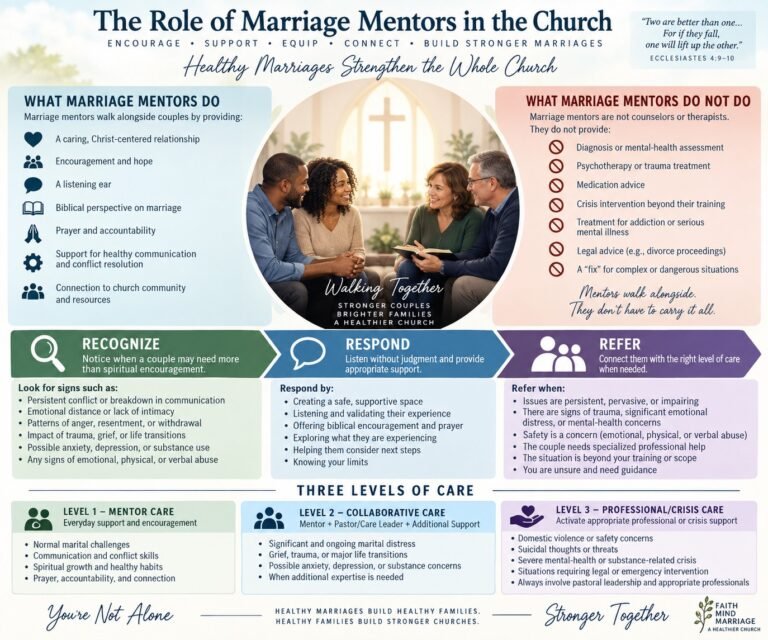
When a mentor recognizes that something is beyond their scope and makes an appropriate referral, they are saying:
“I don’t have to be everything this person needs.”
That is freedom.
A referral isn’t:
“I’m done with you.”
It can be:
“I’m going to help you connect with someone who has the training and experience to address this particular need.”
And when appropriate, the mentor can remain relationally present.
This is especially important when someone is dealing with significant emotional distress, trauma, escalating relational problems, addiction, or a crisis.
The mentor doesn’t have to disappear.
But the mentor shouldn’t have to manage it alone.
Sometimes the Most Spiritual Thing We Can Do Is Get Help
I believe this is an important message for the church.
Seeking professional help does not mean that we have abandoned spiritual care.
Prayer and professional care don’t have to compete.
Biblical truth and emotional understanding don’t have to compete.
Pastoral care and counseling don’t have to compete.
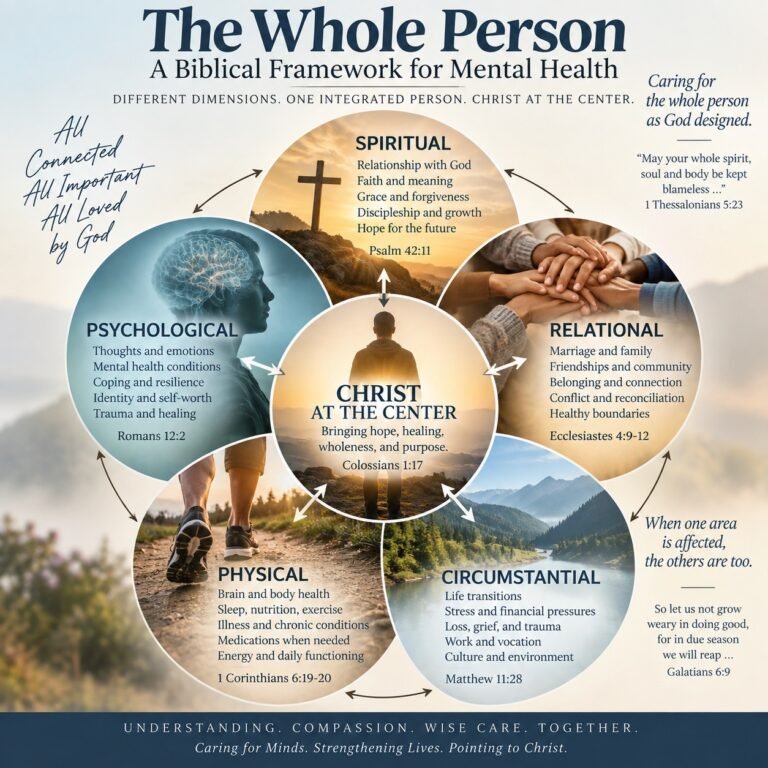
The church doesn’t have to choose between caring for the soul and caring for the whole person.
We can do both.
Sometimes the most spiritually mature response is to recognize our limits and invite someone with different training and experience into the process.
That isn’t a lack of faith.
It can be an expression of wisdom.
Who Is Caring for the Pastor?
Pastors carry a unique burden.
People bring them marriages that are falling apart.
Grief.
Family conflict.
Addiction.
Trauma.
Financial stress.
Spiritual questions.
Mental-health concerns.
Crisis.
And pastors often feel the responsibility to keep leading while carrying all of this.
So we need to ask:
Who does the pastor talk to?
Who knows when the pastor is tired?
Who asks how the pastor is doing—not as a ministry leader, but as a person?
Who provides a safe place for the pastor to process difficult situations?
Who helps the pastor recognize when something needs to be referred rather than personally carried?
A healthy church doesn’t simply ask,
“How is our pastor caring for us?”
It also asks:
“How are we caring for our pastor?”
Who Is Caring for the Mentor?
The same question needs to be asked of mentors.
If we train mentors to recognize, respond, and refer, we also need to give them somewhere to go when they encounter something difficult.
Mentors need supervision.
They need training.
They need clear referral pathways.
They need confidentiality guidelines.
They need someone they can call when they aren’t sure what to do.
And they need permission to say:
“I need help with this.”
That isn’t weakness.
That is what responsible mentoring looks like.
Sometimes the Caregiver Needs to Step Back
There are times when stepping back is actually an act of love.
Not abandoning.
Not withdrawing.
Not becoming indifferent.
But recognizing:
“This situation is affecting me in ways that mean I need support.”
Sometimes we need to step back long enough to breathe.
Sometimes we need to talk with someone.
Sometimes we need supervision.
Sometimes we need professional counseling ourselves.
Sometimes we need to take a break from ministry.
Sometimes we need to grieve.
Sometimes we need to admit that something we have been exposed to has affected us.
The goal isn’t to become emotionally invulnerable.
The goal is to remain healthy enough to continue caring.
We Need a Culture of Care, Not Just a Culture of Service
I think this may be one of the most important shifts we can make in the church.
We are very good at creating cultures of service.
We recruit.
We train.
We mobilize.
We send people out to serve.
But if we aren’t careful, we can create a culture where people are valued primarily for what they do.
Healthy ministry requires something more.
We need a culture of care.
A culture where the people who serve are also seen.
Where asking for help is normal.
Where rest isn’t viewed as laziness.
Where boundaries aren’t viewed as selfishness.
Where referral isn’t viewed as failure.
Where supervision isn’t viewed as weakness.
Where professional help isn’t viewed as a lack of faith.
Where caregivers are reminded that they are people before they are providers of care.
Care for the Caregiver Is Part of the Ministry
If we want our churches to become places of emotional, relational, mental, and spiritual health, we have to start by caring for the people who are doing the caring.
That means asking different questions.
Not only:
“Who needs help?”
But:
“Who is helping them?”
And then:
“Who is helping the helper?”
That creates a healthier system of care.
The pastor doesn’t carry everything.
The mentor doesn’t carry everything.
The counselor doesn’t carry everything.
The small-group leader doesn’t carry everything.
The caregiver doesn’t carry everything.
We carry one another.
And when one person becomes overwhelmed, we don’t simply tell them to carry more faithfully.
We come alongside them.
We listen.
We pray.
We support.
We create space to rest.
We bring additional help when it is needed.
We remind them that they don’t have to be everything to everyone.
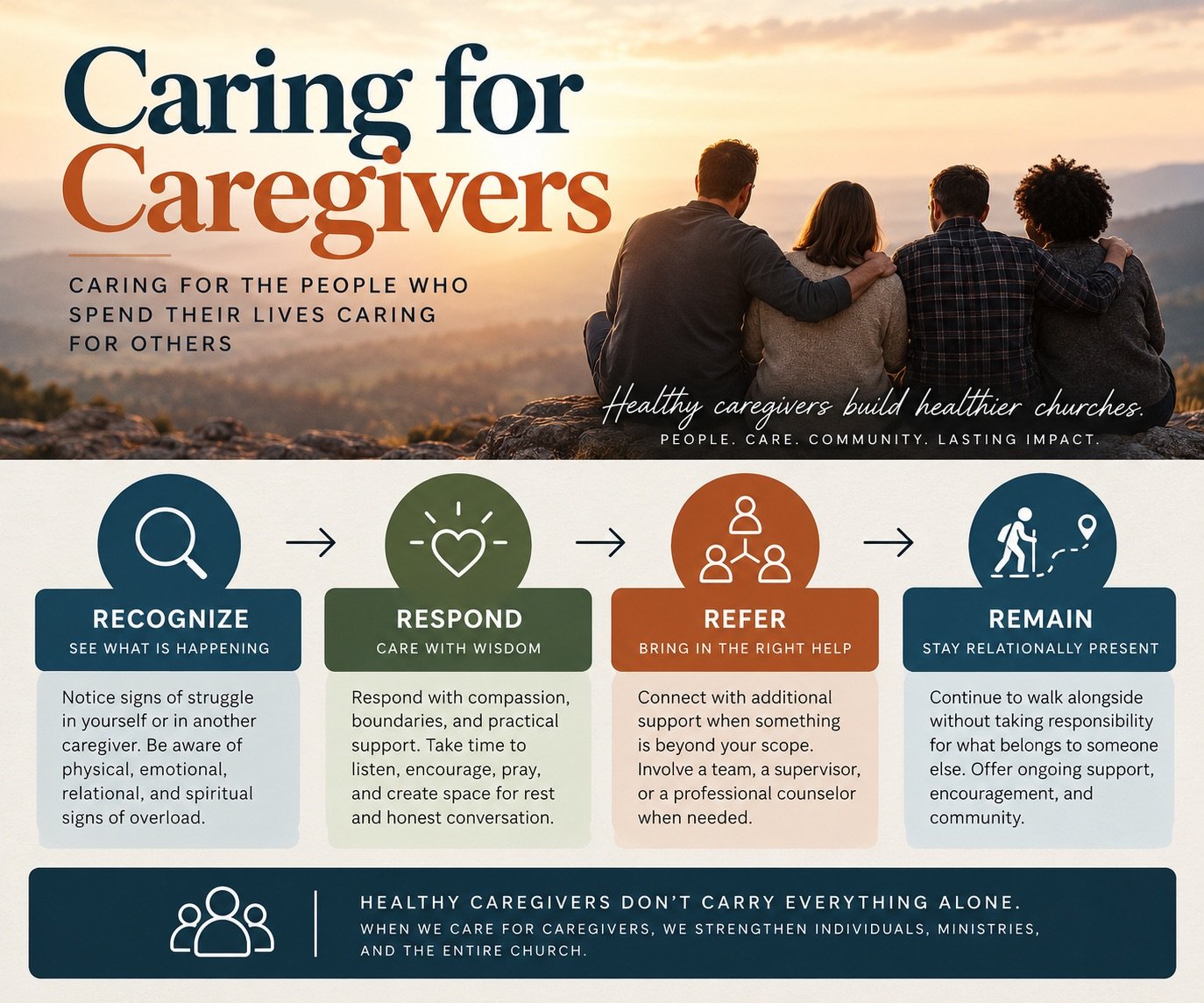
Recognize. Respond. Refer. Remain.
We have talked about Recognize → Respond → Refer as a framework for mentors.
I think there is another word we need to add when we talk about caregivers:
REMAIN.
Recognize what is happening.
Respond with compassion and wisdom.
Refer when something is beyond your scope.
And then, when appropriate, remain relationally present without taking responsibility for what belongs to someone else.
That is what healthy care can look like.
Not fixing.
Not rescuing.
Not carrying everything.
But walking alongside someone while helping them receive the care they need.
The Caregiver Is Worth Caring For
At the end of the day, I think this is what I want caregivers to hear:
You matter too.
Your emotional health matters.
Your spiritual health matters.
Your relationships matter.
Your family matters.
Your sleep matters.
Your boundaries matter.
Your limits matter.
You don’t have to wait until you are completely exhausted to ask for help.
You don’t have to wait until you are in crisis to admit that something is too much.
You don’t have to prove your faithfulness by carrying what God never asked you to carry.
There is no shame in saying:
“I need someone to care for me right now.”
In fact, that may be one of the healthiest things you can model for the people you serve.
Because when we allow ourselves to receive care, we are teaching others that receiving care is not weakness.
It is part of being human.
And it is part of being the Body of Christ.
So perhaps the next time we gather our pastors, mentors, counselors, ministry leaders, and other caregivers for training, we should ask a different question.
Not just:
“How can we equip you to care for others?”
But:
“How can we build a church where you are cared for, too?”
Because caregivers are not resources to be used up.
They are people to be loved.
And if we want to build churches that care well for hurting people, we must learn to care well for the people who are doing the caring.
We don’t just need better caregivers.
We need healthier caregivers.
And healthy caregivers don’t carry everything alone.