The Ministry of Being Present When Someone Is Hurting
There are moments every pastor recognizes. Someone sits across from you and says:
“Pastor, I don’t know what’s wrong with me.”
“I’m struggling in my marriage.”
“I don’t feel anything anymore.”
“I’m angry with God.”
“I’m afraid to tell anyone what I’ve been thinking.”
Almost immediately, your mind begins working:
What Scripture should I give them? What advice should I offer? Who should I refer them to? How can I make this better?
Those questions come from a good place. Pastors are called to shepherd, encourage, teach, pray, guide, and care for people. But what if, for the first few minutes, your job isn’t to fix anything?
What if your first responsibility is simply to listen? Sometimes the most pastoral thing we can do is create enough safety for someone to tell the truth.
Helping Isn’t Always Fixing
Pastors are helpers by nature and by calling. You teach, counsel, encourage, pray, lead, and help people navigate difficult circumstances.
So when someone brings pain into your office, the natural response is:
“How can I help?” But helping and fixing are not always the same thing. When we move too quickly toward a solution, we may unintentionally communicate:
“Your feelings are a problem I need to solve.”
What the person may actually need to hear is:
“Your experience matters enough for me to understand it.”
Before people can receive our wisdom, they often need to experience our willingness to hear them.
Why Listening Matters in Pastoral Care
Listening is not passive. It is an active form of care. People are more willing to be vulnerable when they believe they are emotionally safe:
Safety → Trust → Vulnerability → Honesty → Growth
A person who doesn’t feel safe may give you a carefully edited version of the truth. A person who feels heard may eventually tell you what is really happening. That is one reason listening matters so much when pastors are caring for people experiencing emotional or mental-health concerns.
SAMHSA specifically encourages faith leaders to create environments where people can talk openly, recognize concerns, respond appropriately, and connect people with additional help when needed. (SAMHSA)
Listening is not something we do while preparing our answer. It is part of the ministry itself.
Slow Down and Ask Before You Answer
When someone shares something difficult, our minds naturally begin categorizing:
What’s wrong? What’s the solution? What should I tell them?
Instead, slow down.
Take a breath.
Allow a little silence.
You might simply say:
“Tell me more.”
Or:
“Help me understand.”
A person may say, “We’re having marriage problems,” but that sentence is only the beginning. Rather than immediately offering advice, become curious about the story underneath it.
Ask:
“What’s been happening?”
“When did you first notice this?”
“What has this been like for you?”
“How has this affected you?”
“What kind of support do you think would help right now?”
Questions communicate curiosity. Quick answers can communicate assumptions. Instead of saying:
“Have you tried praying about it?”
ask:
“How have you been experiencing God during this?”
Instead of:
“You need to forgive them,”
ask:
“What has made forgiveness difficult?”
Instead of:
“You shouldn’t be feeling that way.”
ask:
“What do you think is underneath that feeling?”
The goal is not to interrogate.
The goal is to understand.
Listen to the Whole Person
Pastoral care involves more than the presenting problem. When someone comes to you, listen to the whole person.
Spiritual
What is happening in their relationship with God?
What are they believing about God?
Are they experiencing guilt, shame, doubt, or a loss of meaning?
Emotional
What are they feeling?
Are they overwhelmed?
Are they carrying unresolved grief, fear, anger, or shame?
Relational
What is happening in their marriage, family, friendships, or church relationships?
Are they isolated?
Mental and Physical
Has their thinking or ability to function changed?
How are they sleeping?
Are they exhausted?
Could health concerns, medications, or other physical factors be contributing?
These questions do not require a pastor to diagnose. They help reveal whether the person may need support beyond pastoral care. A pastor doesn’t have to determine, “This is depression,” or “This is anxiety,” in order to care well.
The pastor’s role is to listen, recognize what may be happening, and determine when additional assessment or professional care may be appropriate.
Don’t Spiritualize Everything
Pastors can be tempted to spiritualize a problem before understanding it.
Someone says:
“I’m exhausted and overwhelmed.”
And the immediate response is:
“You need to trust God.”
Trusting God may indeed be part of the person’s journey. But the pastor doesn’t yet know the whole story.
The person may also need:
Rest
Prayer
Community
Counseling
Medical evaluation
Marriage support
Grief care
Practical help
Maybe they need several of these things together.
Don’t make a spiritual diagnosis before you’ve listened to the whole story.
And Don’t Psychologize Everything
The opposite extreme is also unhelpful.
Not every spiritual struggle is a mental-health disorder. Not every conflict is trauma. Not every difficult emotion is pathology.
Pastors can remain curious without immediately putting a label on someone’s experience.
Ask:
“What is happening?”
before asking:
“What is this called?”
The goal isn’t to label everything. The goal is to understand the person and identify appropriate care.
Validate the Experience Without Validating Every Conclusion
This is one of the most important skills in pastoral listening.
Someone says:
“Nobody cares about me.”
You don’t have to respond:
“You’re right. Nobody cares.”
Instead, try:
“It sounds like you feel very alone right now.”
Someone says:
“God has abandoned me.”
You might say:
“It sounds like that’s how God feels to you right now.”
These responses acknowledge the person’s experience without automatically agreeing with every interpretation. Validation says, “I hear what you’re experiencing.” It does not necessarily say, “Everything you believe about that experience is true.”
That distinction creates room for both safety and truth.
What Not to Say
Well-intentioned statements can unintentionally shut down a conversation:
“You just need to pray.”
“Everything happens for a reason.”
“You need to have more faith.”
“At least you have…”
“I know exactly how you feel.”
“You need to forgive and move on.”
“God won’t give you more than you can handle.”
“Other people have it worse.”
Instead, try:
“Tell me more.”
“I’m glad you told me.”
“That sounds painful.”
“Help me understand.”
“What has this been like for you?”
“Let’s think about what kind of support you need.”
You might also begin with:
“Thank you for trusting me enough to tell me.”
That simple statement communicates:
You haven’t shocked me. You haven’t disappointed me. I’m still here. We can talk about this.
SAMHSA similarly recommends listening without judgment, asking open-ended questions, expressing support, and thanking people for being willing to talk about what they’re experiencing. (SAMHSA)
When Listening Must Become Action
Listening does not mean waiting indefinitely when someone is in danger.
There are times when pastoral listening needs to become pastoral action.
Think:
Listen → Assess → Act
This becomes especially important when there are concerns about:
Immediate safety
Suicidal thoughts or intent
Abuse
Danger to others
Severe impairment
Inability to care for oneself
Other urgent circumstances
Pastors do not have to handle these situations alone. Faith leaders can be an important part of the support system, while also helping people connect with appropriate mental-health professionals and crisis resources. (SAMHSA)*
Good listening helps us recognize when listening is no longer enough.
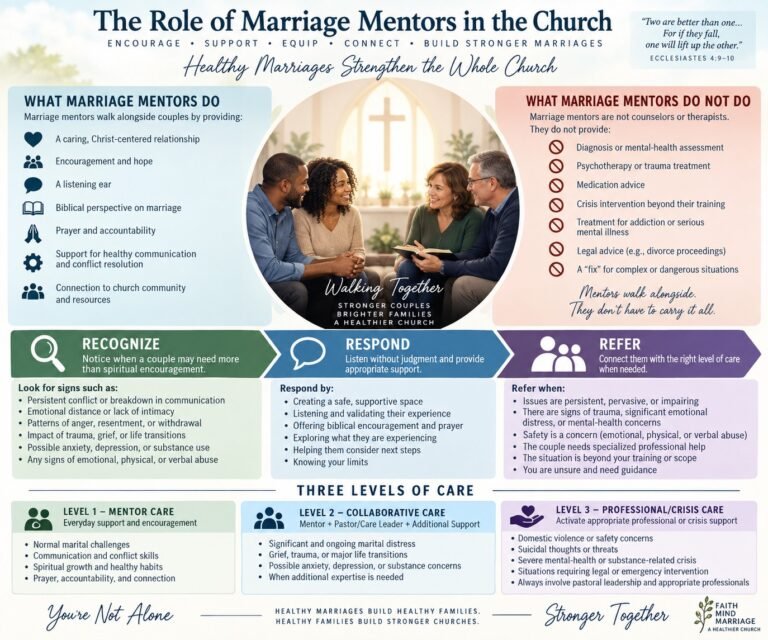
Recognize → Respond → Refer → Remain
This is a framework I believe churches can use when thinking about mental and emotional health.
RECOGNIZE
Something more may be happening.
RESPOND
Slow down.
Listen.
Create safety.
Take the person seriously.
REFER
Connect the person with appropriate professional or specialized help when needed.
REMAIN
Continue appropriate pastoral and community support. Referral is not rejection. It can be an expression of responsible pastoral care.
A pastor doesn’t have to choose between spiritual care and professional mental-health care. Sometimes the most faithful response is knowing when to bring the right people around the person who is hurting.
Jesus Modeled Presence
As pastors, we ultimately look to Jesus.
Jesus asked questions.
He listened.
He noticed people others overlooked.
He showed compassion.
He spoke truth.
He restored dignity.
He was never in such a hurry to fix people that He failed to see them.
People are not problems to solve. They are people to shepherd.
A Simple Listening Tool for Pastors:
L.I.S.T.E.N.
Here’s a simple framework you can remember when someone sits across from you with a difficult story.
L — Lean In
Be present. Put away distractions and give the person your attention.
I — Inquire
Ask questions before making conclusions.
S — Stay Curious
Don’t assume you already know the whole story.
T — Tolerate the Silence. Let people find their words. Silence can be uncomfortable, but it can also give truth, room to emerge.
E — Empathize
Acknowledge what the person is experiencing. You don’t have to agree with every conclusion to recognize someone’s pain.
N — Next Step
After listening, determine what kind of support may be appropriate. The next step may be prayer, another conversation, community, professional counseling, medical care, or urgent intervention. Listen first. Then determine the next step.
Pastoral Care Doesn’t Require You to Fix Everything
Pastors don’t need to become psychologists, psychiatrists, social workers, or trauma specialists to become better listeners. What pastors need is the humility to recognize:
“I don’t have to fix this person. I need to walk with them toward the help and hope they need.” This allows the pastor to remain pastor while professionals provide the specialized care they are trained to offer.
Most importantly, it allows the person who is hurting to experience something profoundly important:
I am not alone.
Sometimes people don’t need us to have the answer. They need to know they aren’t alone while they search for one. Pastoral ministry isn’t always about finding the right words.
Sometimes it is about creating enough safety for someone to speak the words they have been afraid to say. Before we can help people heal, we have to become willing to hear their pain.
A Final Word for Pastors
You don’t have to have the perfect answer when someone walks into your office. You don’t have to solve everything in one conversation. Sometimes your greatest ministry in that moment is to slow down, listen carefully, ask a thoughtful question, and let someone know:
“I’m here. I hear you. We can take the next step together.” That may be where healing begins.