Equipping the Church to Recognize, Respond, and Refer
One of the greatest opportunities churches have today is to develop caring, spiritually mature mentors who can walk alongside people through the ordinary challenges of life.
Mentors can be an incredible source of encouragement. They can listen, pray, provide biblical perspective, offer accountability, and help people recognize opportunities for growth.
But there is an important question every church needs to ask:
What happens when the person we are mentoring needs more than spiritual encouragement?
What happens when grief becomes overwhelming? When anxiety begins interfering with everyday life? When a person has experienced trauma? When depression begins affecting relationships and responsibilities? When a mentor begins to recognize that something has changed but doesn’t know exactly what is happening?
This is where churches need to equip their mentors with something very important:
the ability to recognize when another level of care may be needed.
The goal isn’t to turn mentors into counselors.
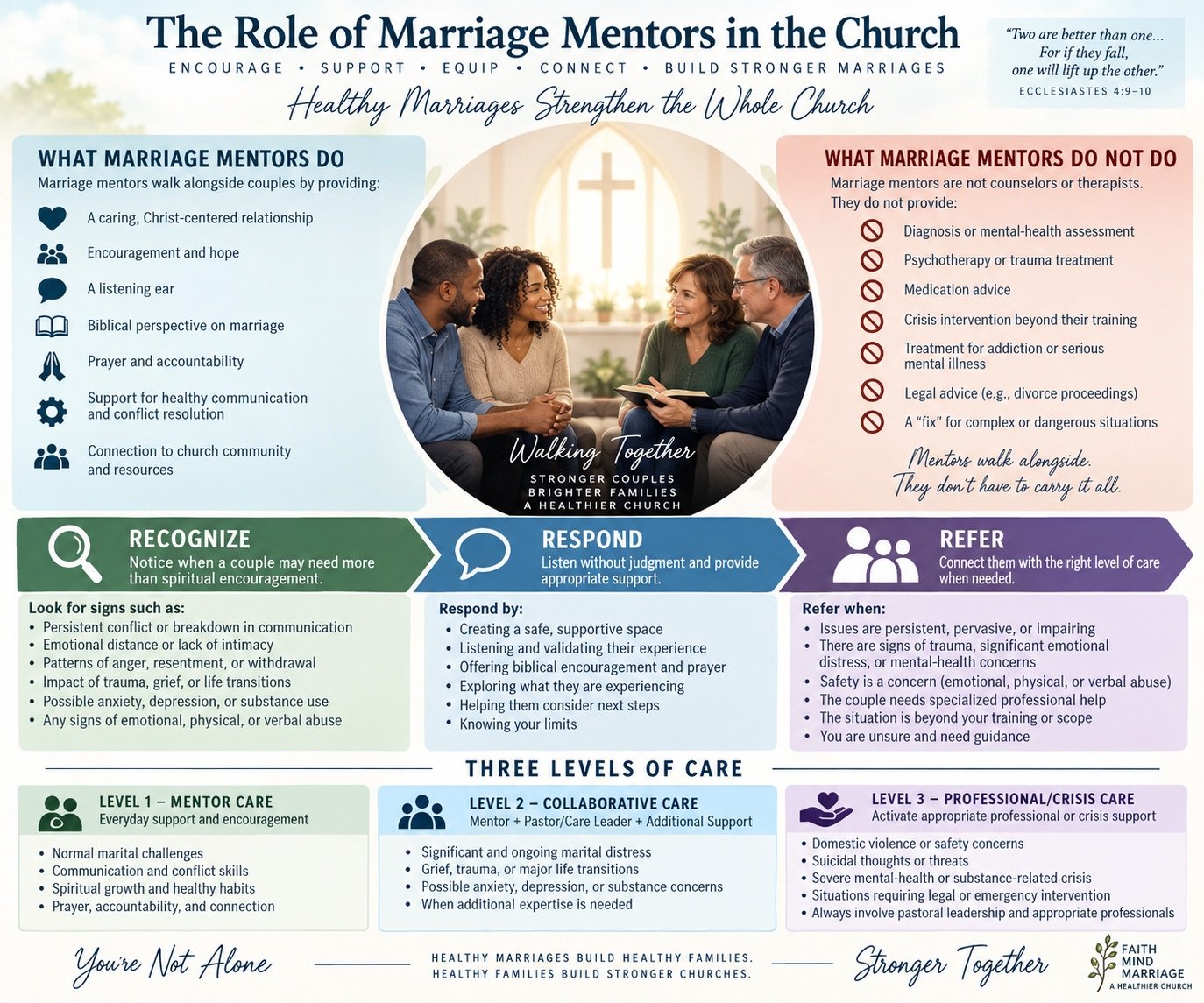
The goal is to help mentors recognize, respond, and refer.
⸻
Mentors Don’t Need to Diagnose
One of the most important principles we can teach mentors is this:
“I don’t have to know what this person has. I need to know when what they are experiencing is beyond my scope.”
Mentoring is not counseling.
A mentor provides relationship, encouragement, listening, biblical perspective, prayer, accountability, support for growth, and connection to the church community.
A mentor does not provide diagnosis, psychotherapy, trauma treatment, medication advice, or treatment for serious mental illness or addiction.
This distinction is important because well-intentioned mentors can sometimes feel responsible for solving the problems of the person they are helping.
They aren’t.
A mentor’s responsibility is not to figure out what is wrong with someone.
A mentor’s responsibility is to notice when something may be beyond the mentor’s role and know what to do next.
That is not a limitation of mentoring.
It is healthy mentoring.
⸻
Spiritual Struggle or Emotional Distress?
This can be one of the more difficult areas for Christian mentors.
Sometimes a person is struggling spiritually.
Sometimes they are experiencing emotional distress.
Sometimes both are happening at the same time.
And sometimes emotional or mental-health challenges make it extremely difficult for someone to engage spiritually in the way they normally would.
A mentor may hear someone say:
“I just don’t feel close to God anymore.”
The mentor might immediately assume the person needs more prayer, Bible study, or spiritual encouragement.
Those things may be helpful.
But there may also be something else happening.
Perhaps the person is grieving.
Perhaps they have experienced trauma.
Perhaps they are overwhelmed by anxiety.
Perhaps they are depressed.
Perhaps they are emotionally exhausted.
Perhaps they haven’t slept well in weeks.
Perhaps they are experiencing a crisis they don’t know how to articulate.
Instead of immediately asking, “What spiritual problem is this?”, teach mentors to ask:
What am I seeing?
Is this primarily:
* A spiritual question?
* A relational problem?
* A normal response to a difficult circumstance?
* Significant emotional distress?
* A trauma response?
* Possible anxiety or depression?
* A crisis?
* Something I don’t understand?
The mentor doesn’t have to answer that last question diagnostically.
Sometimes the wisest conclusion is simply:
“This may require another level of care.”
⸻
Teach Mentors to Look for Change
One of the simplest ways to help mentors recognize potential concerns is to teach them to notice significant changes from a person’s normal functioning.
The mentor may know the person well enough to recognize that something has changed.
That change may show up in several areas.
Behavior
A person may begin:
* Withdrawing from others
* Becoming unusually agitated
* Expressing unusual anger
* Taking significant risks
* Increasing substance use
* Suddenly disengaging from church or relationships
Emotions
A person may experience:
* Persistent sadness
* Intense fear
* Panic
* Emotional numbness
* Extreme irritability
* Persistent hopelessness
Thinking
They may report:
* Difficulty concentrating
* Confusion
* Racing thoughts
* Persistent negative thinking
* Difficulty making ordinary decisions
Relationships
You may notice:
* Increasing isolation
* Repeated conflict
* Loss of trust
* Difficulty maintaining normal relationships
Everyday Functioning
You may see:
* Difficulty working
* Significant sleep disruption
* Changes in eating
* Neglect of personal care
* Difficulty carrying out ordinary responsibilities
The question isn’t:
“Does this person have depression?”
That isn’t the mentor’s job to determine.
Instead, ask:
“Has something changed? How significant is the change? And how much is it interfering with this person’s life?”
That moves the mentor from diagnosis to observation.
⸻
The “Persistent, Pervasive, and Impairing” Framework
One simple framework can help mentors determine when additional support may be appropriate.
Ask three questions:
Is it Persistent?
Has this continued beyond the immediate circumstance?
A person may naturally experience sadness following a loss. Someone may feel anxious before an important event. A difficult week may affect someone’s sleep.
The question is whether the distress is continuing or intensifying beyond what might reasonably be expected.
Is it Pervasive?
Is it affecting multiple areas of life?
Is the person struggling only in one particular circumstance, or is the distress affecting their relationships, work, sleep, family life, spiritual life, and ability to function?
Is it Impairing?
Is it interfering with the person’s ability to function?
Are they struggling to work, sleep, care for themselves, maintain relationships, fulfill responsibilities, or participate in normal activities?
The presence of these characteristics can be an important signal that additional care should be considered.
This is not a diagnostic test.
It is a recognition-and-referral framework.
⸻
Trauma Doesn’t Always Look Like Trauma
This is particularly important for churches to understand.
When we think about trauma, we may imagine someone crying, shaking, or visibly overwhelmed.
But trauma doesn’t always look like that.
A person may experience:
* Fear
* Hypervigilance
* Irritability
* Emotional numbness
* Difficulty sleeping
* Intrusive memories
* Avoidance
* Panic
* Difficulty concentrating
* An exaggerated startle response
* Withdrawal
* Guilt or shame
And sometimes the person will simply say:
“I’m fine.”
while their behavior communicates something very different.
Mentors should never force someone to disclose something they aren’t ready to share.
Instead, they can gently say:
“I’ve noticed that things seem a little different for you lately. How are you doing?”
Then listen.
Sometimes the most helpful thing we can give someone in distress is the freedom to tell their story in a safe environment.
⸻
When Spiritual Encouragement Becomes Spiritual Pressure
Christian mentors want to help.
They want to point people toward God.
They want to encourage faith.
Those are good things.
But when someone is hurting, even well-intentioned spiritual encouragement can sometimes become spiritual pressure.
Statements such as:
“You just need to trust God.”
“You need to pray more.”
“You need to have more faith.”
“Just give it to God.”
“Everything happens for a reason.”
“You need to forgive and move on.”
“The enemy is attacking you.”
may be expressions of beliefs that have an appropriate place in Christian conversation. But when used to shut down someone’s emotional experience, they can leave a hurting person feeling misunderstood or spiritually inadequate.
Instead, teach mentors to slow down.
Try:
“That sounds incredibly difficult.”
“Tell me more about what you’re experiencing.”
“I’m glad you told me.”
“Would it be okay if we prayed together?”
“I wonder if some additional support might be helpful.”
These statements don’t replace spiritual care.
They create space for spiritual care to be received.
⸻
Listen Before You Fix
One of the most important skills we can teach mentors is simply how to listen.
Listening is ministry.
When someone shares something painful, the mentor doesn’t have to immediately provide an answer.
A simple framework can help:
* Listen.
* Clarify.
* Validate.
* Explore.
* Pray.
* Determine next steps.
Instead of immediately telling someone what they should do, ask:
* “What has this been like for you?”
* “How long have you been feeling this way?”
* “How is this affecting you?”
* “What have you noticed changing?”
* “Who else knows what you’re experiencing?”
* “What kind of support do you have?”
* “What would be helpful right now?”
These questions communicate something powerful:
“I am here with you. You don’t have to figure this out alone.”
⸻
Three Levels of Care
Churches can also help mentors by establishing a simple framework for determining what level of care is appropriate.
Level 1: Mentor Care
Mentor care may be appropriate for:
* Normal life challenges
* Spiritual growth
* Everyday relational difficulties
* Decision-making
* Accountability
* Encouragement
* Prayer
At this level, the mentor walks alongside the person.
Level 2: Collaborative Care
Sometimes the mentor remains involved, but additional support is needed.
This might include:
* Significant anxiety
* Persistent symptoms of depression
* Unresolved grief
* Trauma responses
* Escalating marriage problems
* Major life transitions
* Ongoing emotional distress
The model becomes:
Mentor + Pastor/Care Leader + Appropriate Professional Resource
The mentor doesn’t disappear.
Instead, the mentor becomes part of a larger circle of care.
Level 3: Professional or Crisis Care
There are situations a mentor should never attempt to manage alone.
These can include:
* Suicidal thoughts or threats
* Threats toward another person
* Severe inability to function
* Significant loss of contact with reality
* Serious substance-related crisis
* Abuse or immediate safety concerns
* Acute traumatic crisis
At this level, the appropriate pastoral, professional, emergency, or crisis response should be activated.
The mentor’s role is not to solve the crisis.
The mentor’s role is to recognize the crisis and get help.
⸻
How Do We Make a Referral Without Making Someone Feel Rejected?
The way we make a referral matters.
Simply saying,
“You need therapy.”
can unintentionally communicate that the person has failed—or that the church no longer knows what to do with them.
Instead, a mentor might say:
“I’m really glad you’ve trusted me enough to share this. I think what you’re carrying may be more than either of us should handle alone. I’d like to help you connect with someone who has specific training to help with this.”
That communicates four important things:
You are not broken.
You are not failing spiritually.
You are not being rejected.
You deserve appropriate care.
Professional mental-health care doesn’t have to compete with spiritual care.
It can become part of a larger circle of care.
⸻
Churches Need a Clear Care Pathway
Mentor training is only one part of the solution.
Churches also need infrastructure.
Every mentor should know:
Who do I call?
Who supervises me?
When should the pastor be involved?
Who handles a crisis?
Which mental-health professionals does our church trust?
When should emergency services be contacted?
What are the boundaries of confidentiality?
A simple church care pathway might look like:
MENTOR → PASTOR/CARE LEADER → PROFESSIONAL RESOURCE → CRISIS RESPONSE
Of course, immediate safety concerns require an appropriate emergency response rather than waiting for the ordinary referral process.
But the principle is important:
Mentors should never be left wondering what to do next.
A church that expects mentors to recognize mental-health concerns should also provide mentors with a clear pathway for responding to them.
⸻
Confidentiality Has Boundaries
Mentors also need to understand confidentiality.
People need to know that what they share will be treated with dignity and discretion.
At the same time, mentors should never promise absolute secrecy when someone’s safety may be at risk.
A mentor might say:
“What you share with me will be treated with respect and discretion. However, I can’t promise to keep something secret if there is a serious concern about your safety or someone else’s safety.”
This protects both the person receiving care and the mentor.
It also prevents mentors from carrying dangerous information alone.
⸻
Don’t Forget the Mentor
There is one more piece of this conversation that churches sometimes overlook:
Who is caring for the caregiver?
Mentors can become deeply invested in the people they serve.
They may begin feeling responsible for another person’s healing.
They may think about that person’s situation constantly.
They may lose sleep.
They may become emotionally overwhelmed.
They may feel unusually anxious or fearful.
They may begin ignoring their own boundaries.
A healthy mentor learns to ask:
“Am I still able to care for this person without carrying their pain as my own?”
Healthy boundaries aren’t a lack of compassion.
They make sustainable compassion possible.
Mentors need permission to say:
“I care about you, and I also recognize that this is bigger than what I can carry alone.”
⸻
Referral Is Not Failure
Perhaps this is one of the most important messages we can give our churches.
A referral to a mental-health professional is not an abandonment of spiritual care.
It can actually be an expression of humility, wisdom, and love.
The church can say:
“We care enough about you to make sure you receive the kind of help you need.”
Pastors don’t have to become therapists.
Mentors don’t have to become counselors.
Counselors don’t have to become pastors.
We can work together.
The goal isn’t for one person to provide every kind of care.
The goal is to create a community in which the whole person can receive appropriate care.
⸻
Recognize. Respond. Refer.
If I could reduce this entire approach to three words for mentors, they would be:
RECOGNIZE → RESPOND → REFER
RECOGNIZE
Notice significant changes, distress, impairment, trauma responses, or safety concerns.
RESPOND
Listen without judgment.
Create emotional safety.
Offer appropriate spiritual support.
Don’t diagnose.
Don’t attempt to fix what is beyond your role.
REFER
Connect the person with the appropriate level of pastoral, professional, or crisis care.
This is what we want our mentors to understand:
Mentors don’t need to know everything about mental health. They need enough understanding to know when something is more than they can responsibly carry.
That is not stepping outside the mission of the church.
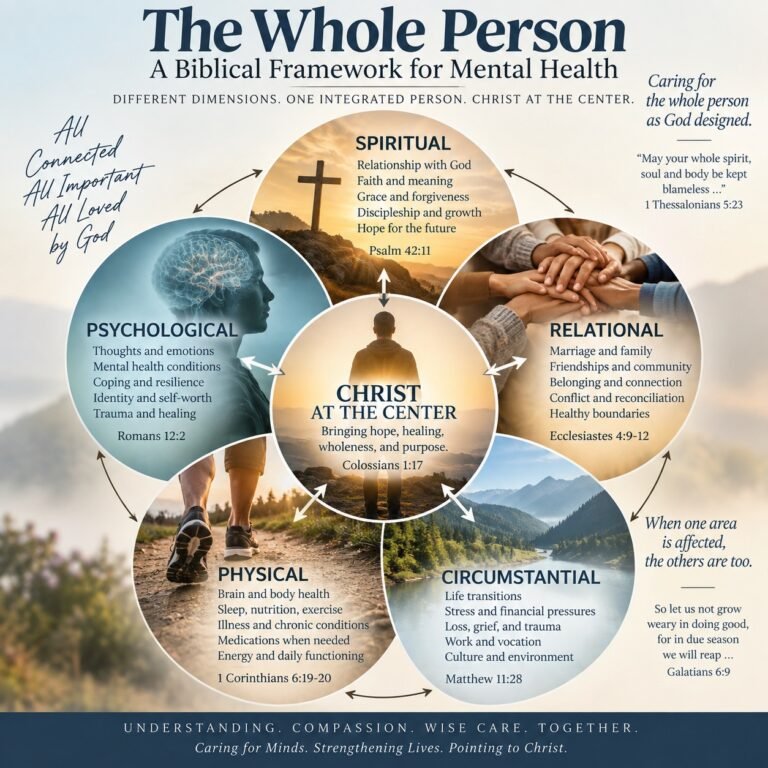
It is part of caring for the whole person.
A Church Prepared to Care for the Whole Person
The church has always been called to care for people spiritually.
But people don’t arrive at our churches as disembodied souls.
They arrive carrying their stories.
They carry their marriages, families, losses, fears, wounds, relationships, disappointments, trauma, questions, and struggles.
They bring their whole selves.
And perhaps one of the most important steps we can take as pastors and church leaders is to equip the people who walk alongside them to recognize when spiritual encouragement is enough—and when love requires us to reach for another level of care.
We don’t have to choose between faith and mental health.
We can pray and listen.
We can encourage and refer.
We can provide spiritual care while also recognizing the value of professional expertise.
We can trust the Holy Spirit while acknowledging that God has also given people gifts, knowledge, training, and resources that can be used to care for His people.
Comprehensive soul care means caring for the whole person—and building a church community equipped to do it well.