Moving from Silence and Stigma to Understanding, Compassion, and Wise Care What if the people sitting in your church every Sunday are struggling emotionally and mentally—but they aren’t sure it is safe to talk about it?
What happens when someone says, “I’m depressed”?
What happens when a pastor hears, “I don’t know how to help my spouse”?
What happens when a mentor realizes that the problem may be more than a spiritual struggle?
And what happens when someone is praying faithfully, loves God deeply, and is still struggling emotionally?
These are not hypothetical questions. Mental health is already part of the life of your church.
The question is whether your church knows how to talk about it. For many pastors and church leaders, this can feel like unfamiliar territory. You may want to help, but you may also wonder what to say, what not to say, and when a situation requires professional help.
The good news is that you don’t have to become a mental-health professional to become more aware, compassionate, and prepared.
The church doesn’t have to choose between spiritual care and mental-health care.
We can care for the whole person—spiritually, emotionally, relationally, and mentally.
Why Is It So Difficult for the Church to Talk About Mental Health?
There are several reasons this conversation can be difficult. Fear
Church leaders may be afraid of saying the wrong thing. They may worry about opening a problem they don’t know how to handle or becoming involved in an area outside their training.
There can also be a fear that talking openly about mental health somehow means the church is becoming less spiritual.
Stigma
Many Christians have grown up hearing messages such as:
“If you really trusted God, you wouldn’t feel this way.”
“Christians shouldn’t need therapy.”
“Depression means you’re spiritually weak.”
“You just need to pray more.”
Even when these statements are well-intentioned, they can cause people to hide what they’re experiencing. Instead of bringing their pain into the light, they may suffer quietly because they are afraid of being judged.
Confusion
Church leaders may also struggle to distinguish between a spiritual struggle, emotional distress, relational dysfunction, mental-health concerns, and situations that require professional intervention.
We don’t help people by making every problem a spiritual problem.
But neither do we help them by making every problem a psychological problem.
We help people by learning to recognize what they need.
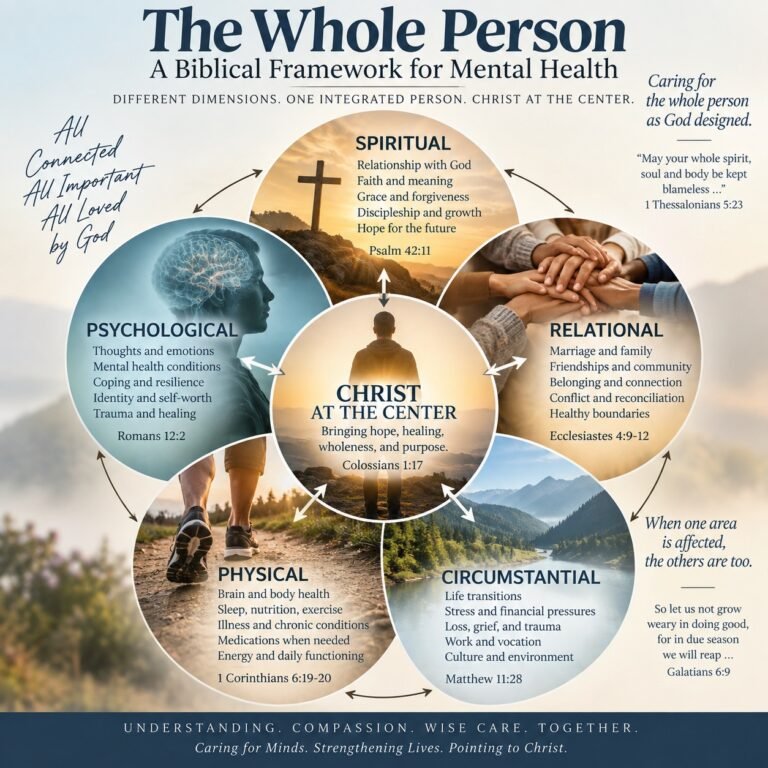
Start With the Whole Person
One of the most important shifts a church can make is learning to see people as whole people.
When someone is struggling, we can ask:
Spiritually:
What is happening in this person’s relationship with God?
Emotionally:
What are they feeling? Can they identify and express those emotions?
Relationally:
What is happening in their marriage, family, friendships, or community?
Mentally:
Are there concerns that may require a mental-health assessment or professional care?
These dimensions often overlap. Ministering to the whole person necessitates looking at the bigger picture and recognizing that relation ships, emotions, mental health and relationship with God are all a part of soul-care.
A person experiencing marital conflict may also be experiencing anxiety. Someone grieving may struggle with depression. Someone experiencing trauma may have difficulty connecting spiritually or relationally.
Healthy ministry doesn’t ignore mental health.
It recognizes that God created us as whole people.
Sometimes We Need to Change Our Language Creating a healthier church culture can begin with something very simple: changing the way we talk to people who are hurting.
Instead of saying:
> “You just need to pray about it.”
Try:
> “Tell me more about what you’re experiencing.”
Instead of:
> “You need to have more faith.”
Try:
> “How can I walk alongside you while you’re going through this?”
Instead of:
> “That’s a spiritual problem.”
Try:
> “Let’s take some time to understand what’s happening.”
And instead of immediately saying:
> “You need counseling.”
Try:
> “Would it be helpful to talk with someone who has specialized training in this area?”
Sometimes the first step toward helping someone isn’t giving them an answer.
It’s creating a safe place for them to tell you what is really happening.
Asking for Help Is Not a Failure Churches have an important opportunity to change the way Christians understand struggle.
We can help people distinguish between:
Failure and struggle.
Sin and suffering.
Spiritual immaturity and emotional pain.
Isolation and community.
Needing help does not mean someone’s faith has failed.
Sometimes asking for help is one of the healthiest expressions of humility.
The church should be a place where people can acknowledge that they are struggling without feeling that they have failed God.
Create a Culture of Emotional Safety
People are much more likely to tell the truth when they feel safe.
They need to know they will be:
-
Heard
-
Respected
-
Believed
-
Not judged
-
Not rushed
-
Not immediately given an answer
Trust creates safety.
Safety creates vulnerability.
Vulnerability creates honesty.
And honesty creates the possibility for meaningful conversation.
If we want people to talk about their mental and emotional health, we have to create environments where they can believe:
> *“I can tell the truth about what I’m experiencing, and I won’t be rejected because of it.”*
That is an important ministry environment for every church to cultivate.
What Should a Pastor Say When Someone Says, “I’m Struggling”?
One of the most helpful things a pastor can learn is not to immediately try to solve the problem.
Start with curiosity.
You might say:
“Tell me what struggling looks like for you.”
Then ask:
-
“How long have you been feeling this way?”
-
“How is this affecting your daily life?”
-
“How are things going at home?”
-
“Who knows what you’re experiencing?”
-
“What kind of support do you currently have?”
-
“What would be most helpful to you right now?”
And when appropriate, ask directly about safety:
“Is there anything happening that makes you concerned about your safety?”
That question can be an important bridge to recognizing when professional or emergency help may be necessary.
Asking the question doesn’t mean you have failed as a pastor.
It means you are taking the person’s well-being seriously.
Know the Role of the Church—and Know Its Limits
This is an especially important principle for pastors and church leaders.
The church has an essential role in caring for people.
The church can provide:
-
Community
-
Prayer
-
Biblical encouragement
-
Discipleship
-
Mentoring
-
Pastoral care
-
Practical support
-
Accountability
-
Connection
But there are times when someone also needs:
-
Professional counseling
-
Psychiatric evaluation
-
Medical assessment
-
Specialized treatment
-
Crisis intervention
Knowing when to refer someone is not abandoning them. It is caring for them responsibly.
A referral shouldn’t communicate:
> “You’re someone else’s problem now.”
It can communicate:
> **“Let’s find the right help, and I’ll continue to walk alongside you where appropriate.”**
Professional care and spiritual care can work together. They don’t have to compete. Equip the People Who Are Already Caring for Others Not every church needs a mental-health professional on staff. But every church can benefit from equipping the people who are already caring for others.
These may include:
-
Pastors
-
Elders
-
Small-group leaders
-
Marriage mentors
-
Women’s mentors
-
Men’s mentors
-
Coaches
-
Ministry leaders
-
Lay counselors
These individuals don’t need to become mental-health professionals. But they do need to understand their role—and their limits.
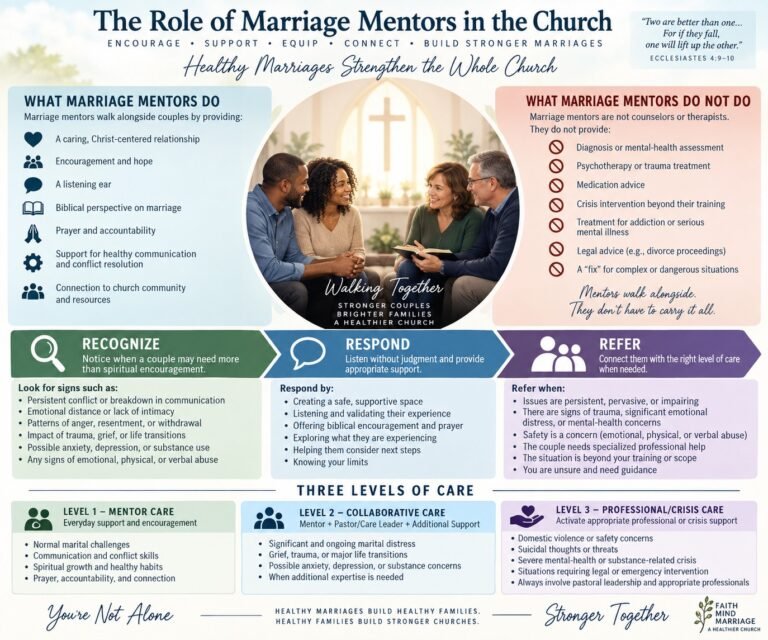
One simple framework can help:
RECOGNIZE → RESPOND → REFER → REMAIN → RECOGNIZE
Learn to notice the signs that someone may be struggling.
RESPOND
Listen with compassion rather than immediately trying to fix the problem.
REFER
Connect the person with appropriate professional resources when additional help is needed.
REMAIN
Continue appropriate spiritual and community support.
Recognize. Respond. Refer. Remain.
This is not about turning church leaders into therapists.
It is about helping them become wiser caregivers.
What Would a Mental-Health-Aware Church Look Like?
Imagine a church where someone can say:
“I’m struggling.”
—and they don’t have to feel ashamed.
Imagine a church where pastors don’t feel like they have to become therapists.
Where therapists aren’t viewed as replacing spiritual care.
Where mentors understand their boundaries.
Where couples can receive both spiritual and relational support.
Where leaders know when to refer.
Where prayer and professional care aren’t treated as enemies.
And where people are encouraged to seek help early rather than waiting until they reach a crisis.
That is the kind of church we can build.
The goal isn’t to turn the church into a mental-health clinic.
The goal is to make the church a safer place for people who need help.
Seven Practical Steps Your Church Can Take
You don’t have to change everything at once.
Start somewhere.
-
Begin talking about mental health from the pulpit. Help your congregation understand that emotional and mental struggles are not topics that have to remain hidden.
-
Teach your leaders how to listen. Listening is often more powerful than immediately offering advice.
-
Create a referral resource list. Identify trusted counselors, therapists, psychiatrists, medical professionals, crisis resources, and other qualified providers in your community.
-
Build relationships with qualified Christian mental-health professionals. Don’t wait until a crisis occurs to figure out where you can send someone for help.
-
Train your mentors and ministry leaders. Help them understand what they are equipped to do—and what falls outside their role.
-
Create a culture where asking for help isn’t shameful. Let your congregation hear the message repeatedly: Seeking help is not a failure of faith.
-
Make emotional and mental health part of discipleship.
Don’t talk about mental health only when someone is in crisis.
Healthy emotional awareness, relationships, boundaries, grief, conflict resolution, and help-seeking can all become part of how we disciple people toward maturity.
Start the Conversation
Think about the people who will sit in your church this Sunday.
Some may be experiencing anxiety.
Some may be experiencing depression.
Some are grieving.
Some have experienced trauma.
Some are struggling in their marriages.
Some are lonely.
Some are dealing with addiction.
Some are overwhelmed by stress.
And some may be carrying emotional pain that no one knows about.
The question isn’t whether mental health belongs in the church.
It already does.
The question is:
Are we prepared to talk about it?
You don’t have to know everything about mental health.
You don’t have to have all the answers.
But you can learn how to begin the conversation.
And perhaps that conversation begins with three simple words:
“Tell me more.”
When we create churches where people don’t have to hide their emotional and mental struggles in order to belong, we create communities that reflect the compassion of Christ.
Because caring for the whole person means caring for the spiritual, emotional, relational, and mental dimensions of who God created us to be. Let’s start the conversation.