When Trauma Enters the Church: Why Pastors Need to Understand Mental Health
The morning began like any other Sunday.
The sanctuary foyer was rapidly filling with worshipers. The organ could be heard softly playing through the open sanctuary doors. People were arriving, greeting one another, finding their seats, and preparing for worship.
I sat quietly in the back row with my infant daughter.
My husband was already on the platform, sitting beside the senior pastor. We were young pastors, in our mid-thirties, serving together in an Assemblies of God fellowship. One of our primary responsibilities was pastoral care.
I watched my husband lean forward and say something to the senior pastor. The pastor nodded.
The service began.
Approximately fifteen or twenty minutes into the service, a loud bang came from the middle of the sanctuary.
Suddenly, people were moving. There was confusion. People scattered. I tried to understand what was happening.
Then I saw my husband jump from the platform, hurdle over the bench in front of him, and move quickly toward the middle of the sanctuary.
I would later learn what had happened.
A man and his wife had been seen arguing in the foyer before entering the sanctuary. During the service, the man pulled out a revolver and shot his wife in the temple.
She immediately slumped forward beside the person sitting on her other side, blood spilling onto his white shirt.
My husband ran to her.
He used handkerchiefs to apply pressure to her wound while emergency personnel were called.
A retired police officer who happened to be sitting nearby wrestled with the shooter and held him until authorities arrived.
And I?
An elder quickly came to me, told me to follow him, and took me into an office. He put my infant daughter and me underneath a desk and told me to stay there.
So I did.
For what felt like a very long time, I remained there with my baby.
Eventually, I realized that no one was coming back to tell me what was happening or what I should do. I crawled out from underneath the desk, picked up my daughter, and tentatively made my way back toward the sanctuary.
By then, the police had arrived. The shooter had been taken away. The woman had been transported to the hospital.
The church had experienced something none of us expected.
When the Church Doesn’t Know What to Do
At that time, we thought of the church as a haven—a safe place where people could come, worship, trust one another, and find care.
But that morning exposed something important.
We were not prepared for trauma.
The senior pastor directed the elders, deacons, and ushers to take everyone into the gymnasium, which was adjacent to the church building. The church also housed a school.
People gathered.
An offering was taken.
And eventually, everyone was told to go home.
There was no intentional trauma response plan. There was little understanding of what people might experience emotionally in the hours, days, weeks, and months following such an event.
It was my first experience with trauma in the church.
It would not be my last.
────────
Thirty Years Later: Trauma Came Again
Almost thirty years later, I found myself in another church in another city.
This time, my husband and I were serving in the church’s Life Safety Ministry. We were trained to mobilize and help people in the immediate aftermath of a critical event.
I was in a meeting room with faculty members from a Christian university whose satellite campus was located at the church.
The service had not even begun.
A young man entered the church foyer from the parking lot and began firing a weapon indiscriminately.
Before entering the building, he had also fired into the parking lot, killing two young parishioners.
A church security guard ultimately stopped the shooter.
Once again, the church had experienced unimaginable trauma.
But this time, I had a role.
I began functioning as a Life Safety minister. I moved through the room where people had been evacuated. I talked with them. I listened. I encouraged them. I tried to help reduce the stress and fear that were surrounding us.
I was doing what I had been trained to do.
But there was something I didn’t fully understand at the time:
I was also a victim of the traumatic event.
In the days that followed, returning to the church became extremely difficult for me. Eventually, I began experiencing panic attacks.
I had been helping others process trauma while simultaneously discovering that I was experiencing trauma myself.
That experience taught me something I believe pastors and church leaders need to understand:
The people helping others are not necessarily immune to the effects of trauma.
────────
Trauma Doesn’t Always End When the Event Is Over
About a year later, another crisis occurred in the same church.
A senior pastor was suddenly removed from the pastoral staff, leaving the church without its lead shepherd.
For many people, this was another profound emotional shock.
As I continued talking with people, listening to their stories, and offering encouragement, I began to recognize something significant.
Many people were still struggling with the effects of the church shooting that had occurred more than a year earlier.
They had never fully processed what had happened.
They were still carrying fear, grief, anger, confusion, and uncertainty.
And now another major disruption had occurred.
They were emotionally depleted.
They had not recovered from the first trauma before another crisis arrived.
This is an important reality for pastors to consider:
A new crisis can reopen an old wound.
People don’t experience each crisis in isolation. We bring our previous experiences, losses, fears, unresolved grief, and emotional vulnerabilities with us into the next difficult event.
────────
The Church Has Learned Much About Spiritual Care. What About Whole-Person Care?
Eventually, a new senior pastor was called.
As often happens when leadership changes, organizational structures were reorganized. The Life Safety Ministry was eventually disbanded.
My husband and I suddenly found ourselves without an active ministry role.
And we were both struggling with the effects of what had happened over the previous year and a half.
Those experiences profoundly influenced the direction of my ministry.
I had been on both sides of the equation.
I had been a pastor’s wife.
I had been involved in pastoral care.
I had served alongside church leaders.
I had experienced trauma as a member of the congregation.
I had helped people immediately following traumatic events.
And I had worked as a licensed professional counselor, helping people address emotional and mental-health challenges.
Over time, I became increasingly aware of a significant weakness—not necessarily in one particular church, but within the broader church culture.
We have often been equipped to care for the spiritual person without being equally equipped to recognize and respond to the emotional and mental-health needs of that same person.
This is not an argument for replacing spiritual care with professional mental-health care.
Quite the opposite.
I believe the church has an extraordinary opportunity to bring these two areas of care together.
────────
The Church Should Not Have to Choose Between Faith and Mental Health
When someone experiences trauma, grief, anxiety, depression, or overwhelming stress, their spiritual life doesn’t suddenly disappear.
But neither does their emotional and neurological response to what has happened.
Emotional distress can become a filter through which people interpret their circumstances, relationships, faith, and even their understanding of God.
During seasons of intense emotional pain, it may become difficult for someone to hear what they believe God is saying because the internal noise is so overwhelming.
That doesn’t necessarily mean they lack faith.
It may mean they are hurting.
And that distinction matters.
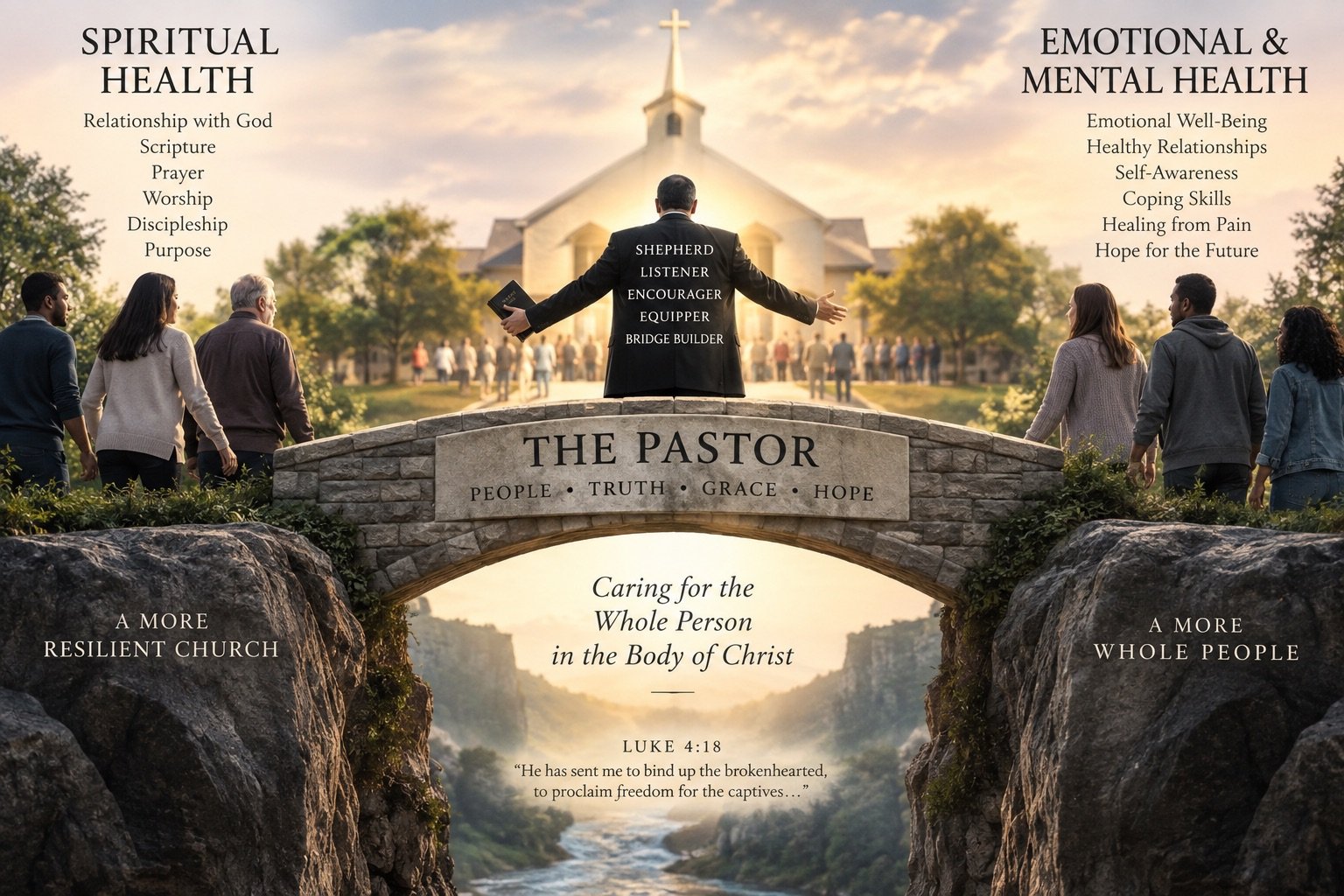
As pastors, we don’t need to become mental-health professionals.
But we do need to become more informed about mental health.
We need to know enough to recognize when someone may be experiencing acute stress, trauma, anxiety, depression, complicated grief, or symptoms that require professional attention.
We need to know how to listen.
We need to know how to respond.
And perhaps most importantly, we need to know when to say:
“This is bigger than what I can provide. Let’s find someone who can help.”
That isn’t a failure of pastoral ministry.
It is wise pastoral care.
────────
What Does Comprehensive Soul Care Look Like?
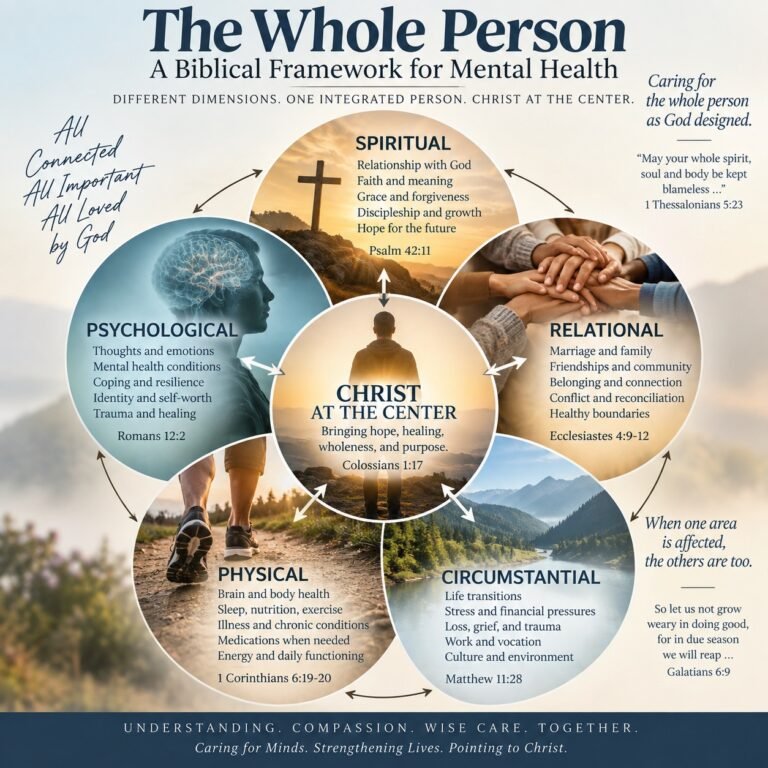
I believe the church is uniquely positioned to care for the whole person.
We are spiritual beings.
We are emotional beings.
We are relational beings.
And our mental and emotional well-being affects how we experience nearly every area of life.
Comprehensive soul care doesn’t mean pastors become therapists.
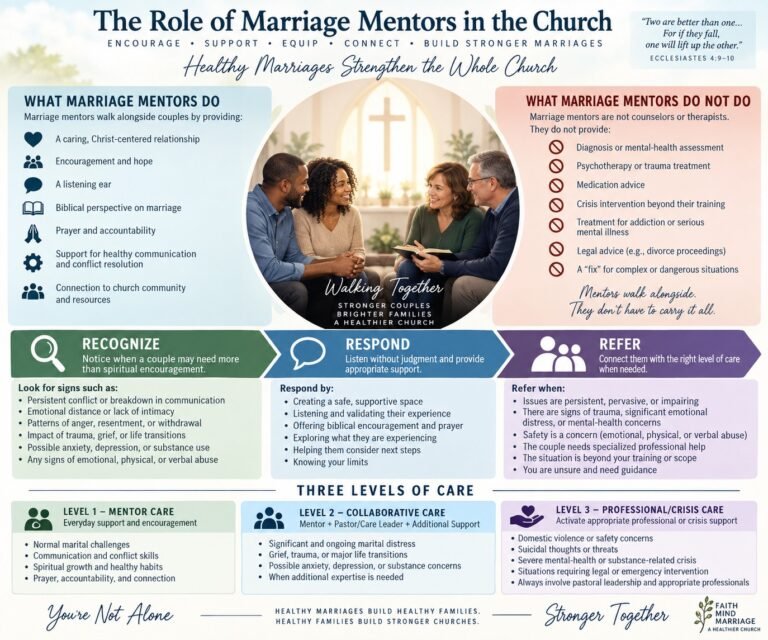
It means the church develops a team of care.
That team might include:
• Pastors and pastoral staff
• Trained lay mentors
• Marriage mentors
• Small-group leaders
• Stephen Ministers or similar care ministries
• Mental-health professionals
• Medical professionals when appropriate
• Trusted members of the congregation who understand how to provide compassionate support
Each person has a role.
The pastor provides spiritual leadership and pastoral care.
The trained mentor provides relationship, encouragement, and accountability.
The mental-health professional provides specialized assessment and treatment.
And the church community provides something that people desperately need:
A safe place to belong.
────────
Pastors Are Asking the Right Questions
If you are a pastor or church leader, you may already be asking questions like these:
How does my church begin to incorporate mental health into our ministry?
What do I need to understand about trauma?
How can we develop a spiritually and mentally healthy church?
How can we train our mentors to recognize when someone needs more than spiritual encouragement?
What should a church do following a traumatic event?
How do we care for our congregation without expecting pastors to become mental-health professionals?
What kind of team should we build to care comprehensively for the people God has entrusted to us?
These are important questions.
And I believe the church is ready to have this conversation.
────────
A New Conversation for the Church
My ministry is moving in a new direction.
I want to help pastors and church leaders understand the relationship between faith, mind, and emotional health.
I want to help churches recognize the effects of trauma.
I want to help pastors understand the basics of acute stress and post-traumatic stress.
I want to help churches develop lay ministries and mentoring structures that can provide appropriate emotional support.
And I want to help pastors recognize when a person needs professional mental-health care—and how to make that transition without making the person feel rejected, judged, or spiritually deficient.
Most importantly, I want to help us move toward a model of ministry that recognizes that soul care is whole-person care.
The church doesn’t have to choose between trusting the Holy Spirit and understanding mental health.
We can do both.
We can pray.
We can listen.
We can walk alongside people.
We can provide wise pastoral care.
And when necessary, we can connect people with trained professionals.
That is not a compromise of faith.
It can be an expression of faithful stewardship of the people God has placed in our care.
────────
Let’s Ask the Questions Together
My upcoming podcast series, Faith, Mind & Marriage: How to Equip the Church for Comprehensive Soul Care, will explore these questions and many more.
We’ll talk about trauma.
We’ll talk about emotional safety.
We’ll talk about anxiety and depression.
We’ll talk about marriage and relationships.
We’ll talk about mentoring.
We’ll talk about the role of pastors, lay leaders, and mental-health professionals.
And we’ll talk about how the church can become a place where people don’t have to hide their emotional pain in order to demonstrate their faith.
Because sometimes the most spiritual thing we can do is acknowledge that someone is hurting—and then walk with them toward the help they need.
Pastors and church leaders, let’s have this conversation together.
Let’s learn how to care not only for the spiritual needs of God’s people, but for the whole person.
Faith. Mind. Marriage.
Comprehensive soul care for the church.